Welcome to Quanzhou Weihang Machinery Co.,Ltd.

In the world of mechanical tools, the hydraulic jack stands out as a remarkable invention that simplifies the task of lifting heavy loads. Whether it's in an automotive repair shop, a construction site, or a manufacturing facility, hydraulic jacks are widely used due to their efficiency and power. But have you ever wondered how these seemingly simple devices are able to lift objects many times their own weight? In this article, we will delve into the inner workings of hydraulic jacks and explore the fascinating principles that make them so effective.

Pascal's Law: The Foundation of Hydraulic Jack Operation
At the heart of every hydraulic jack is Pascal's law, a fundamental principle in fluid mechanics. Pascal's law states that when pressure is applied to an enclosed, incompressible fluid, that pressure is transmitted undiminished to every portion of the fluid and to the walls of the containing vessel. In simpler terms, this means that if you apply a small force to a small area of fluid in a closed system, the resulting pressure will be distributed evenly throughout the entire system. This principle is what allows hydraulic jacks to multiply force and lift heavy loads with relative ease.
The Anatomy of a Hydraulic Jack
To better understand how a hydraulic jack works, let's take a closer look at its basic components. A typical hydraulic jack consists of two main parts: a pump and a cylinder. The pump is used to create pressure in the hydraulic fluid, while the cylinder is where the force is applied to lift the load.
The pump is usually a hand-operated lever or an electric motor that drives a piston. When the pump is activated, the piston moves back and forth inside a chamber, creating a vacuum on one side and pressure on the other. This action forces the hydraulic fluid to flow from a reservoir into the chamber and then out through a tube connected to the cylinder.
The cylinder is a cylindrical chamber that contains a piston. The piston is connected to a rod that extends out of the cylinder and is used to lift the load. When the hydraulic fluid enters the cylinder, it exerts pressure on the piston, causing it to move upward and lift the load. The size of the piston and the cylinder determine the amount of force that can be generated by the jack.
How a Hydraulic Jack Works
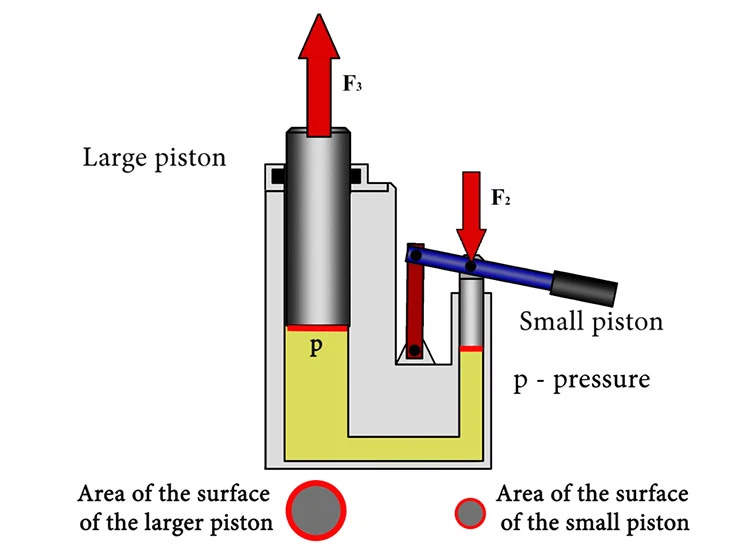
Now that we have a basic understanding of the components of a hydraulic jack, let's see how they work together to lift a heavy load. When the pump is activated, the piston inside the pump chamber moves back and forth, creating a pressure differential. This pressure differential causes the hydraulic fluid to flow from the reservoir into the pump chamber and then out through the tube connected to the cylinder.
As the hydraulic fluid enters the cylinder, it exerts pressure on the piston. According to Pascal's law, the pressure exerted on the piston is equal to the pressure applied by the pump. Since the area of the piston in the cylinder is larger than the area of the piston in the pump, the force exerted on the piston in the cylinder is much greater than the force applied by the pump. This is known as force multiplication.
For example, let's say the area of the piston in the pump is 1 square inch and the area of the piston in the cylinder is 10 square inches. If a force of 10 pounds is applied to the piston in the pump, the pressure created in the hydraulic fluid is 10 pounds per square inch (psi). According to Pascal's law, this pressure is transmitted undiminished to every portion of the fluid and to the walls of the containing vessel. Therefore, the pressure exerted on the piston in the cylinder is also 10 psi. Since the area of the piston in the cylinder is 10 square inches, the force exerted on the piston in the cylinder is 100 pounds (10 psi x 10 square inches). This means that the hydraulic jack has multiplied the force applied by the pump by a factor of 10.
As the piston in the cylinder moves upward, it lifts the load. The amount of load that can be lifted by the jack depends on the force generated by the piston and the mechanical advantage of the jack. The mechanical advantage of a hydraulic jack is the ratio of the force output to the force input. In the example above, the mechanical advantage of the jack is 10 (100 pounds of force output divided by 10 pounds of force input).
There are several different types of hydraulic jacks available on the market, each designed for specific applications. Some of the most common types of hydraulic jacks include:
· Floor Jacks: These are the most common type of hydraulic jack and are used to lift cars, trucks, and other vehicles. Floor jacks typically have a low profile and are designed to be used in a horizontal position.
· Bottle Jacks: These are small, portable hydraulic jacks that are shaped like a bottle. Bottle jacks are often used for light-duty applications, such as lifting small appliances or furniture.
· Hydraulic Cylinders: These are large, heavy-duty hydraulic jacks that are used in industrial applications, such as construction, manufacturing, and mining. Hydraulic cylinders are typically used to lift very heavy loads and can be customized to meet specific requirements.
· Scissor Jacks: These are a type of mechanical jack that uses a scissor-like mechanism to lift a load. Scissor jacks are often used as a backup or emergency jack and are not as powerful as hydraulic jacks.
Applications of Hydraulic Jacks
Hydraulic jacks have a wide range of applications in various industries. Some of the most common applications of hydraulic jacks include:
· Automotive Repair: Hydraulic jacks are used to lift cars, trucks, and other vehicles for maintenance and repair work. Floor jacks and bottle jacks are the most commonly used types of hydraulic jacks in automotive repair shops.
· Construction: Hydraulic jacks are used to lift heavy loads, such as building materials, equipment, and machinery, on construction sites. Hydraulic cylinders are often used in construction applications due to their high lifting capacity.
· Manufacturing: Hydraulic jacks are used to lift and position heavy parts and components during the manufacturing process. Hydraulic cylinders are commonly used in manufacturing applications to provide precise control and positioning of parts.
· Mining: Hydraulic jacks are used to lift heavy loads, such as ore and rock, in mining operations. Hydraulic cylinders are often used in mining applications due to their high lifting capacity and durability.
· Transportation: Hydraulic jacks are used to lift and position heavy loads, such as shipping containers and trailers, in transportation applications. Hydraulic cylinders are commonly used in transportation applications to provide precise control and positioning of loads.
Conclusion
In conclusion, hydraulic jacks are a powerful and versatile tool that uses Pascal's law to multiply force and lift heavy loads. By understanding the basic principles of how hydraulic jacks work, you can appreciate the engineering behind these amazing devices and use them more effectively in your work or projects. Whether you're a mechanic, a construction worker, or a DIY enthusiast, a hydraulic jack is an essential tool to have in your toolkit.
Quanzhou Weihang Machinery Co.,Ltd.


